
Showing posts with label Math Doctor Multiplication. Show all posts
Showing posts with label Math Doctor Multiplication. Show all posts
Tuesday, July 5, 2016
Math Doctor Video - New Version
See Math Doctor Link for the new Math Doctor Video - write out a 10 by 10 multiplication in under 1.5 minutes.


Thursday, June 2, 2016

Wednesday, July 22, 2015
The 10% Rule RULES! Part One

You can calculate any percentage using the 10% rule.
No need to remember any rules, formulae or part/whole/percent triangles.
Example 1: What is 15% of 40?
Start by finding 10%.
To find 10%,

chop off the "0" in 40 and you have...
4
5% is half of 10%. Half of 4 is 2, so you need another
2
4 + 2 = 6
DONE! Work SMART not HARD
Example 2: What is 15% of 42?
There's no zero to chop!


Think of 42 as "42 decimal" or "42." Move that decimal one place to the left and you have 4.2
This is your 10%.
5% is half of 10%. Half of 4.2 is 2.1, so you need another
2.1
4.2 + 2.1 = 6.3
DONE! Work SMART not HARD
Wednesday, July 8, 2015


Thursday, June 18, 2015
Percent Video (Type 4)
Percent Video (Type 4)
Percent Video (Type 4)
I have identified at least 5 distinct types of percent questions. (There may be more...) These include...
1) One number expressed as a % of another
4) Percent change
1) One number expressed as a % of another
2) Finding a certain % of a given number
3) (For want of a better title) The good old "650 is 15 % of what number" type of question.
4) Percent change
5) Increasing or decreasing a number by a given percentage
Here's the link for the 4th of 5 videos in a series on percent questions.
Wednesday, June 17, 2015
Percent Video (Type 3)
Percent Video (Type 3)
I have identified at least 5 distinct types of percent questions. (There may be more...) These include...
1) One number expressed as a % of another
4) Percent change
1) One number expressed as a % of another
2) Finding a certain % of a given number
3) (For want of a better title) The good old "650 is 15 % of what number" type of question.
4) Percent change
5) Increasing or decreasing a number by a given percentage
Here's the link for the 3rd of 5 videos in a series on percent questions.
Wednesday, May 6, 2015
Trick Question!


What is the difference between the biggest and smallest of these three numbers?
HINT: Don't work out the three numbers! (They are 21, 23 and 25, by the way). The difference between the largest and smallest of any three given consecutive positive odd numbers is 4. Try it...
1,3,5
3,5,7
etc.
How much precious exam time would you have used up trying to work out that question?
Work SMART, not HARD.
Wednesday, April 8, 2015
3 out of 4 - Again. What if there is no 3rd number?
Here's a quick review...
"A 10 metre flag pole casts a shadow of 6 metres. A 12 metre pole would cast a shadow that is ______ metres in length."
 "A motorcyclist rides 125 miles in 3 hours. At this rate, how much distance will be covered in 5 hours?"
 A factory produces 3000 widgets every 45 minutes. How many widgets will be produced in 7 hours?
These questions, I like to call, are "3 out of 4" questions. You are given 3 numbers and you need to find the 4th. How to solve? Make yourself a 4-way relationship box.
Let's look at question 1 again.
"A 10 metre flag pole casts a shadow of 6 metres. A 12 metre pole would cast a shadow that is ______ metres in length."
Your two "measurements" are height (H) and shadow length (SL).
H SL
10 6
12 ?
Remember MUADO - Multiply Up and Across, Divide by the Other Number.
12 x 6 = 72
72/10 = 7.2
You could have set your box up another way.
H 10 12
SL 6 ?
6 x 12 = 72
72/10 = 7.2
Same answer...
Tricks to watch out for!
In question 3, the two "measurements" are time and widgets. However, the first "time" is in minutes and the second one is in hours. You need to either convert the 45 minutes to .75 hours, or convert the 7 hours to 420 minutes. Then set up your box, remember MUADO, and get yourself the right answer.
So...
For example...
You need to answer 40 questions correctly on an exam in order to get the 80% passing mark. How many questions are on the exam?
Your two "measurements" are questions answered correctly (Q) and percent (%).
Q %
40 80
? 100
Another example...
Pat can cut a lawn in 45 minutes? How long will it take Pat to cut 2.5 lawns?
The third number is 1 - "a lawn" = 1.
Your two "measurements" are lawns (L) and time (T).
L T
1 45
2.5 ?
"A 10 metre flag pole casts a shadow of 6 metres. A 12 metre pole would cast a shadow that is ______ metres in length."
These questions, I like to call, are "3 out of 4" questions. You are given 3 numbers and you need to find the 4th. How to solve? Make yourself a 4-way relationship box.
Let's look at question 1 again.
"A 10 metre flag pole casts a shadow of 6 metres. A 12 metre pole would cast a shadow that is ______ metres in length."
Your two "measurements" are height (H) and shadow length (SL).
H SL
10 6
12 ?
Remember MUADO - Multiply Up and Across, Divide by the Other Number.
12 x 6 = 72
72/10 = 7.2
You could have set your box up another way.
H 10 12
SL 6 ?
6 x 12 = 72
72/10 = 7.2
Same answer...
Tricks to watch out for!
In question 3, the two "measurements" are time and widgets. However, the first "time" is in minutes and the second one is in hours. You need to either convert the 45 minutes to .75 hours, or convert the 7 hours to 420 minutes. Then set up your box, remember MUADO, and get yourself the right answer.
So...
What if the question has no 3rd number?
For example...
You need to answer 40 questions correctly on an exam in order to get the 80% passing mark. How many questions are on the exam?
Where's the 3rd number?
The third number is 100 - the % means 100.
Q %
40 80
? 100
Another example...
Pat can cut a lawn in 45 minutes? How long will it take Pat to cut 2.5 lawns?
Where's the 3rd number?
Your two "measurements" are lawns (L) and time (T).
L T
1 45
2.5 ?
Monday, March 9, 2015
Scientific Notation

Looks difficult but is an easy mark on the GED exam.
See this link for an explanation.
Wednesday, November 19, 2014
Multiplication Tables in under 2 minutes - Back by Popular Demand
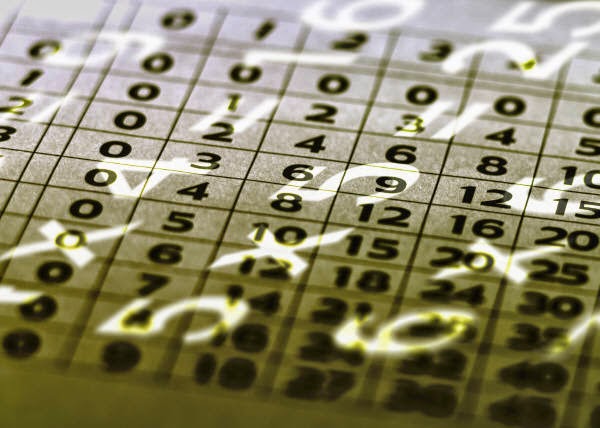
Can you write out the multiplication table to 10 by 10 in under 2 minutes...
We're nearly up to 1400 hits on this video. I have had all kinds of praise for the content. The video itself was done on a budget of about 59 cents and the "special effects" need upgrading but the ideas are certainly worth sharing. See...
Math Doctor
Wednesday, March 12, 2014
Multiplication Tables
You cannot take your multiplication tables into the GED exam with you. But what if you could write them out on a spare piece of paper in under 2 minutes. See the Math Doctor on Youtube for the solution. He has the prescription.
Subscribe to:
Posts (Atom)